
Table of Contents
2018
A recurring challenge
At the farm I grow mostly cucurbits (summer and winter squash, pumpkins, and melons). In previous years I noticed that melons in particular would some of the time wilt and die before any fruit matured. I looked without success for causes and cures. There was a suggestion in one website that this can be caused by cucumber beetles who transmit a harmful bacterium to the plant's internal systems that slows down the flow of moisture and nutrients. The page included some tests to determine if this was the cause. (I always see a few spotted cucumber beetles at the start of the season, but in the past, only a few.) Neither of the two tests indicated bacterial wilt was present, but some plants wilted and died.
2018 was different
This year I found that these beetles were not only nibbling away one the leaves, but they were slicing off stems, effectively killing transplants. I tried the usual, spraying Neem oil, row cover, and picking them off, but without much effect. They were everywhere.
As plants grew, especially the several varieties of melon that I was trying (Dark Tail Mountain watermelon, Oregon Delicious, Pike and Farthest North muskmelons) almost all of these wilted and appeared sickly before maturing fruit. Overall, this killed 28 of 36 plants. We were lucky to have 3 ripe melons for ourselves and the food banks not lucky at all regarding tasty melons.
The problem?
Most way through the season I was motivated to research likely causes and find a cure for next season.
What I found was disheartening. There is a bacterium that lives in the soil. Cucumber beetles lay eggs around the base of plants they like to eat and these eggs hatch into larvae who live in the soil until they become beetles. The resulting beetles carry with them the bacterium and transfer it to the plants as they nibble. Inside the plants these bacteria thicken the juices flowing in the stems, reducing the transfer of moisture and nutrients between root and fruit.
AND, cucumber beetles just love cucurbits! They lay eggs at the base of each one, planning for a quick return. I had prepared a garden that was most appealing to them and given them invitations for next year.
I read that more than one beetle per 4-inch tall plants constitutes an infestation. And these pests can overwinter in our mild off-season temperatures, so they stick around.
A solution?
So how to deal with this? Mmmmm, the question is how to deal with it for organic production. I couldn't find a way, other than what I had already tried, which was clearly ineffective. The one solution I found was a (very expensive) pesticide to be sprayed into the soil to kill the larvae before they emerge as adults. Once they are adults, these beetles are very difficult to kill. Well known pesticides such as carbaryl, malathion and a formulation consisting of rotenone and pyrethrin may work if applied repeatedly, but these can kill beneficial insects and their effects may be marginal.
So, I must develop a plan B for 2019, which likely involves not growing cucurbits at all. The same results have occurred that the garden in Fall City, so just moving production to it isn't an option either.==
Biological control
Non-pesticide solutions may include ground beetles, soldier beetles, braconid wasps, tachinid flies, and entomopathogenic nematodes.
A bright spot?
I grew a few varieties of cucurbit that are less appealing to spotted cucumber beetles: Sunburst Scallop yellow squash, Dark Star zucchini, REBA acorn squash and Butterbush. These pests nibbled, but didn't destroy the plants or severely limit production.
The striped cucumber beetle
Their cousins, striped cucumber beetles, paid a visit, too. They turned up later in the season just in time to nibble away all the silks from sweet corn. The result of this was cobs without kernels. A neighbor gardener lost his entire corn crop to these.
They are doubly sinister because they also attack roots and reduce plant health.
More information
Utah State University Extension service has a page devoted to these pests.
USU Extension also has a vegetable production and pest management guide.
But there were some happier moments
Drip irrigation
 I've done drip irrigation both at the Farm and the Garden for some time. In the Garden I used mostly drip tape. At the Farm I used mostly drip lines. The two approaches use different lines, pressure regulators and fittings. A recent consolidation at the Farm included separate drip lines for the grapes and the vegetables in the remainder of the garden. Adding wind-up timers and a manifold to the setup allowed me to water each area separately for different times.
Sunflowers
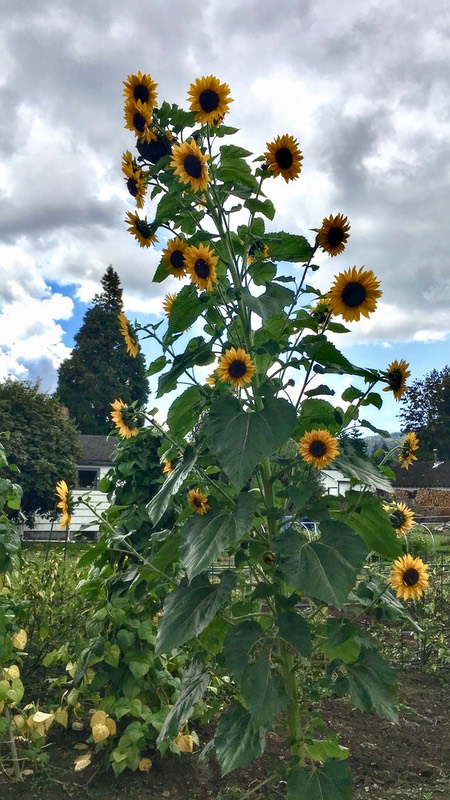 Tall sunflowers with lots of blossoms. I tried transplanting sunflower seedlings with little success. It worked much better to broadcast seeds and then work them down into the soil. There were different varieties in a seed packet, which resulted in some exceptionally tall and prolific plants. I liked those best with lots of flowers. On one I counted almost 50 blossoms.
The old, rejuvenated strawberry bed
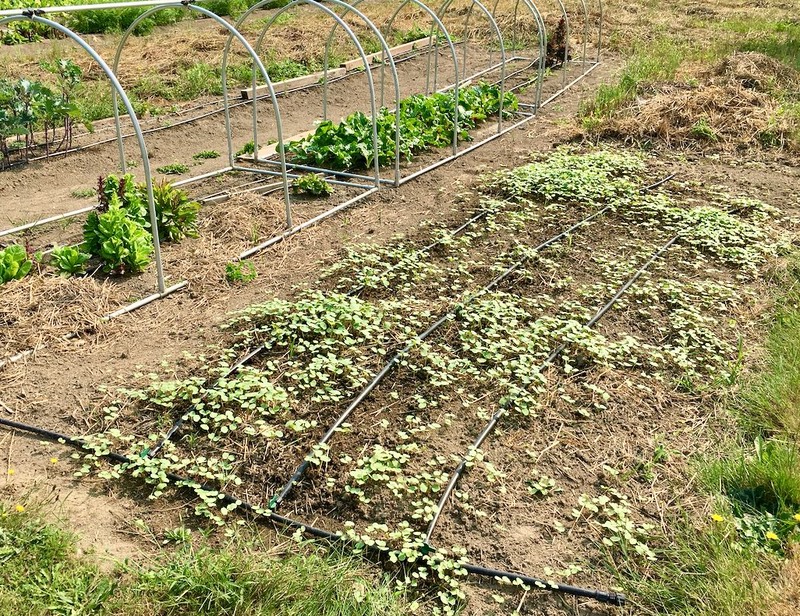 The old, rejuvenated strawberry bed. I grew strawberries in a small area at the edge of the garden and had decent harvests. There were numerous runners from the previous season here, so I collected them and started a new, bigger bed for following seasons.
A new strawberry bed
 For the coming season I made a new strawberry bed. I hoped to limit the presence of weeds to make it easier to manage so I covered it with a plastic mulch and cut holes for each runner, then transplanted one to each hole. This was tedious and I hoped that it would same some time and cultivation in the future.
Healthy growing plants
 After failures caused by the cucumber beetles, I chose to stick with plants that had a a better track record in the Garden - greens, brassicas, tomatillos, onions and potatoes.
And lots of marigolds
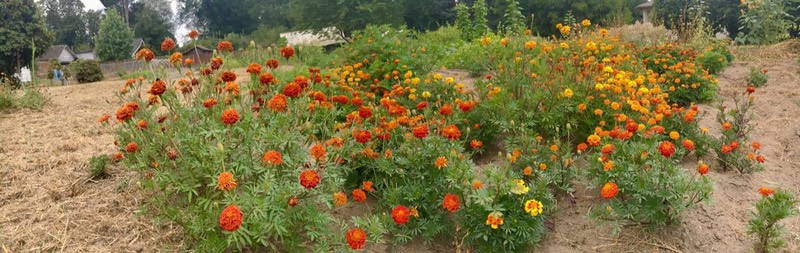 And lots of marigolds. For several years now these were the favorite home of most pollinators. The variety was intended as a cover crop - from Osborne Seeds nearby - their
French Marigold Petite Mix.
And lots of marigolds. For several years now these were the favorite home of most pollinators. The variety was intended as a cover crop - from Osborne Seeds nearby - their
French Marigold Petite Mix.
Really it was a good year!
There were more challenges than in the past. By many measures it was a good year:
- I harvested move than 2,500 pounds of produce.
- I donated over 2,000 pounds to two local food banks.
- I gave a hundred pounds to family and friends.
- We filled up our freezer with vegetables and have supplies of winter squash.
It comes as no surprise to me that my body is tired. I was working in the gardens well into October. I am taking time to recuperate.
View a gallery of 2018 photos.